Leva-me, vento leve, mas não me leves inteiro.
Deixa ficar aqui os pés que ainda querem chão,
as mãos que ainda tateiam o escuro em busca de outra mão,
o coração que insiste em ser órgão, não metáfora.
Cabeça e tronco separados — essa é a invenção moderna:
a cabeça voando em direção aos lucros,
o tronco arrastado pelas dívidas,
e entre eles, um vão onde a alma deveria estar
mas está alugada, hipotecada, vendida em prestações
a juros compostos e consciência pesada.
Mente e alma, essa antiga dualidade barata —
como se a mente fosse o escritório e a alma o depósito,
como se uma pudesse funcionar sem a outra,
como se a contabilidade da vida coubesse em partidas dobradas.
Não é propriamente meu esse desequilíbrio.
Não fui eu quem separou o pensar do sentir,
quem fez do afeto um produto,
da alegria uma meta a ser atingida com metas,
da tristeza uma doença a ser medicada em três doses diárias.
Inventivamente inventaram isso em mim.
Com que fineza de navalha, com que precisão cirúrgica
me inseriram a culpa como um chip,
me programaram o desejo como um algoritmo,
me venderam a felicidade como um pacote de milhagem
que expira antes da viagem.
Oh, sábios detratores, doutores do rebaixamento,
vós que trabalhais para companhias excusas
— aquelas sem rosto, sem sede, sem vergonha —,
vós que fazeis do rebaixamento um ofício
e da mediocridade alheia vosso salário.
Conheço-vos bem.
Sois os mesmos que crucificaram o profeta e venderam a cruz como relíquia.
Os mesmos que silenciaram o poeta e depois lhe compraram os versos por metro.
Os mesmos que fizeram do sol uma lâmpada a ser paga no fim do mês.
Trabalhais, sim, trabalhais:
no turno da manhã, espalhais a notícia de que o bem é ingenuidade;
no turno da tarde, ensinais que o amor é negócio mal administrado;
no turno da noite, escreveis os relatórios que justificam
deixar os bons por baixo, sempre por baixo,
como carpete, como alicerce, como terra onde os palácios se erguem.
E vende-se, vende-se, vende-se:
vende-se logo um medicamento para a tristeza de existir,
vende-se a alma em kit de autoconhecimento,
vende-se flores no dia em que o amor é obrigatório,
vende-se caixões em parcelas que cabem no bolso,
vende-se documentos que provam que você é você
— por apenas trinta reais, promovemos seu esquecimento.
Tudo se vende, tudo tem preço:
o choro da criança que quer colo vira transtorno de apego,
a revolta do jovem que não aceita o mundo vira crise de identidade,
a exaustão do trabalhador vira síndrome,
a solidão do velho vira doença neurodegenerativa.
Há sempre um comprimido, sempre um laudo, sempre um diagnóstico.
Há sempre uma empresa, sempre um lobby, sempre uma campanha.
Há sempre uma maneira de transformar a dor em lucro,
a vida em consumo,
a morte em oportunidade de negócio.
Mas eu, vento leve, eu te peço:
leva-me não para longe, mas para dentro.
Para o centro exato onde ainda não chegaram os vendedores.
Para o santuário íntimo que ainda não foi zoneado,
patenteado, leiloado, rateado entre acionistas.
Leva-me para aquele lugar onde a cabeça e o tronco ainda conversam,
onde a mente e a alma ainda se reconhecem como irmãs siamesas
— separá-las seria a morte de ambas.
E de lá, deste ponto cego do mercado,
desta bolha de ar no grande oceano das mercadorias,
deixa-me ver o mundo como ele é:
não como me vendem, não como me convencem,
mas como ele geme nas suas fundações
esperando que alguém, um dia,
recuse o medicamento e aceite a cura,
recuse a alma empacotada e aceite o vazio criador,
recuse as flores murchas do calendário
e plante no chão úmido da própria carne
a semente do que ainda pode ser.
Porque os bons estão por baixo, sim.
Mas é por baixo que as raízes crescem.
É por baixo que a terra fermenta.
É por baixo que o mundo, quando rui,
encontra o chão firme para recomeçar.
Vento leve, vento justo,
leva-me, sim.
Mas leva-me para o fundo.
Para o subsolo da existência.
Para onde os vendedores não descem
porque não há lucro, não há escala, não há retorno.
E de lá, deste aquário escuro e fértil,
deixa-me subir — não como produto,
não como alma à venda,
não como consumidor satisfeito —,
mas como testemunha.
Como aquele que viu o sistema por dentro
e preferiu o desequilíbrio sagrado
à equilíbrio morto dos que se vendem inteiros.
Leva-me, vento.
Mas deixa que eu volte.
Com os pés no chão,
com a cabeça nos ombros,
com a alma onde sempre esteve
— escondida, sim,
mas não à venda.
Um poema de Wagner Merije
…
Take me, gentle wind, but do not take me whole.
Leave here the feet that still want ground,
the hands that still grope the dark in search of another hand,
the heart that insists on being organ, not metaphor.
Head and trunk separated — that is the modern invention:
the head flying toward profits,
the trunk dragged by debts,
and between them, a void where the soul should be
but is rented, mortgaged, sold in installments
with compound interest and heavy conscience.
Mind and soul, that ancient cheap duality —
as if the mind were the office and the soul the warehouse,
as if one could function without the other,
as if life’s accounting fit into double-entry books.
This imbalance is not properly mine.
It was not I who separated thinking from feeling,
who made affection a product,
joy a goal to be achieved with goals,
sadness a disease to be medicated in three daily doses.
Inventively they invented this in me.
With what finesse of razor, with what surgical precision
they implanted guilt in me like a chip,
programmed desire in me like an algorithm,
sold me happiness like a mileage package
that expires before the journey.
Oh, wise detractors, doctors of debasement,
you who work for shady companies
— those without face, without headquarters, without shame —,
you who make debasement a profession
and others’ mediocrity your salary.
I know you well.
You are the same who crucified the prophet and sold the cross as a relic.
The same who silenced the poet and later bought his verses by the meter.
The same who made the sun a lightbulb to be paid at month’s end.
You work, yes, you work:
on the morning shift, you spread the news that good is naivety;
on the afternoon shift, you teach that love is poorly managed business;
on the night shift, you write the reports that justify
keeping the good ones down, always down,
like carpet, like foundation, like earth where palaces rise.
And they sell, they sell, they sell:
they quickly sell a medication for the sadness of existing,
they sell the soul in a self-knowledge kit,
they sell flowers on the day love is mandatory,
they sell coffins in installments that fit in the pocket,
they sell documents proving you are you
— for just thirty reais, we promote your forgetting.
Everything is sold, everything has a price:
the cry of the child who wants to be held becomes attachment disorder,
the revolt of the young who won’t accept the world becomes identity crisis,
the worker’s exhaustion becomes syndrome,
the old person’s loneliness becomes neurodegenerative disease.
There is always a pill, always a report, always a diagnosis.
There is always a company, always a lobby, always a campaign.
There is always a way to turn pain into profit,
life into consumption,
death into business opportunity.
But I, gentle wind, I ask you:
take me not far away, but inward.
To the exact center where the sellers have not yet arrived.
To the intimate sanctuary not yet zoned,
patented, auctioned, divided among shareholders.
Take me to that place where head and trunk still converse,
where mind and soul still recognize each other as Siamese twins
— to separate them would be the death of both.
And from there, from this blind spot of the market,
from this air bubble in the great ocean of commodities,
let me see the world as it is:
not as they sell it to me, not as they convince me,
but as it groans in its foundations
waiting for someone, someday,
to refuse the medication and accept the cure,
to refuse the packaged soul and accept the creative void,
to refuse the wilted flowers of the calendar
and plant in the moist soil of one’s own flesh
the seed of what may still be.
For the good ones are down below, yes.
But it is down below that roots grow.
It is down below that earth ferments.
It is down below that the world, when it crumbles,
finds firm ground to begin again.
Gentle wind, just wind,
take me, yes.
But take me to the depths.
To the basement of existence.
To where the sellers do not descend
because there is no profit, no scale, no return.
And from there, from this dark and fertile aquarium,
let me rise — not as product,
not as soul for sale,
not as satisfied consumer —,
but as witness.
As one who saw the system from within
and preferred the sacred imbalance
to the dead balance of those who sell themselves whole.
Take me, wind.
But let me return.
With feet on the ground,
with head upon shoulders,
with soul where it has always been
— hidden, yes,
but not for sale.
A poem by Wagner Merije
…
DESCRIÇÃO DA IMAGEM:
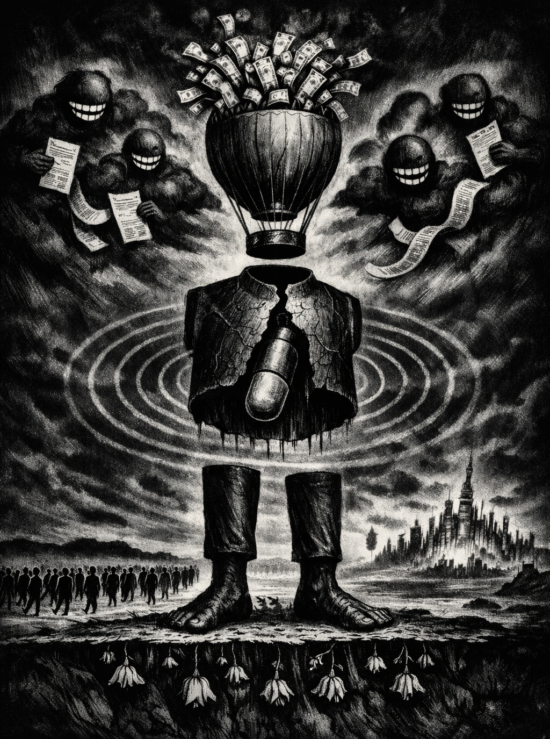
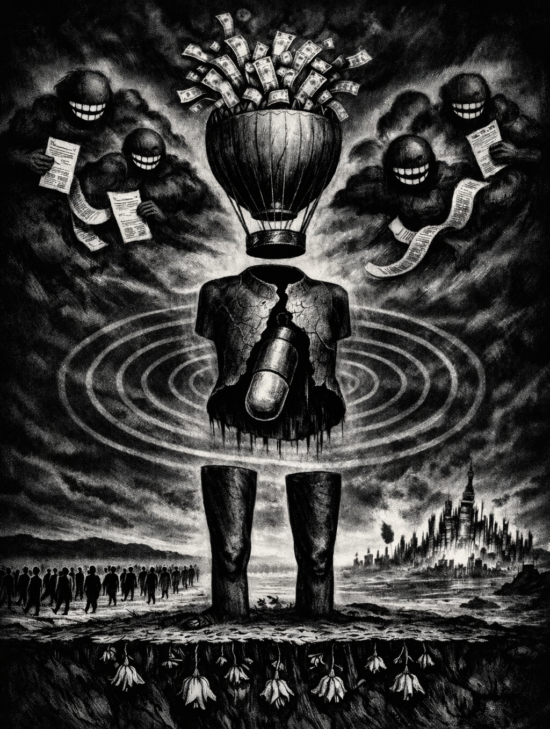
Uma figura humana fragmentada flutua em um céu tempestuoso de tons cinza e prata. O corpo está dividido em três partes principais que não se tocam: a cabeça, transformada em um balão aerostático inflado por notas de dinheiro que escapam como ar quente; o tronco, que pende pesadamente como um sino de igreja rachado, com um badalo em forma de comprimido batendo silenciosamente contra suas paredes internas; e as pernas, que permanecem fincadas em um chão árido onde flores murchas crescem de cabeça para baixo, suas raízes expostas ao céu.
Ao redor da cabeça-balão, pequenas figuras sem rosto — os detratores — flutuam em nuvens escuras, segurando contratos e prescrições médicas que se desenrolam como serpentinas fúnebres. Eles sorriem com dentes que são cápsulas de remédio.
Do tronco-sino, um som silencioso escapa em ondas concêntricas, cada onda carregando palavras: “alma”, “flores”, “caixões”, “documentos” — que se dissolvem no ar antes de alcançar o chão.
No horizonte, uma linha tênue de luz separa o céu tempestuoso de uma planície infinita onde milhares de figuras minúsculas, de cabeças baixas, caminham em direção a um ponto de venda que brilha como uma cidade de papel.
O estilo é de uma gravura expressionista alemã — contrastes dramáticos, linhas angulares, texturas granuladas — com a precisão surrealista de um sonho de Kafka dirigido por Bergman.


